Tuesday, 20 March 2018

Mary Poppins, the magical nanny

At your exam in June you will be requested to talk about one of the suggested topics and "My favourite book for children by an English writer" is on the list. Speaking about this topic you should demonstrate your knowledge of the classical works of the English literature for children. 
"Marry Poppins" by Pamela L. Travers is a wonderful choice. Have you read this book or maybe watched a film? Which adjectives come to your mind when you think about Mary Poppins' character? Write your answer in the comments.
Created in the early 30s Mary Poppins is still in the public's imagination even though newer fantasies have appeared. In the 2012 Summer Olympics opening ceremony in London, England, multiple Mary Poppinses descended from the roof of the stadium on wires to save children from Lord Voldemort, a character from the Harry Potter books.

Read the extracts from the following article "Mary Poppins and a Biography of Her Creator, P. L. Travers"
- A Magical Nanny

- The First Mary Poppins Book

- The Mary Poppins Series

- The Mary Poppins Movie

Summarize what you have read. You may find useful these tips for writing a summary .

As for the screen versions of "Mary Poppins" you can get the idea of what the original Walt Disney movie was like by watching this trailer:
A new adoptation of the famous story is expected soon:

In case you haven't watched it yet there's a Soviet musical based on this book.

Saturday, 3 March 2018

You can help to save the planet too! Just think of what you can do.

When we talk about environmental problems we also discuss possible solutions to them. It is very inspiring to learn about green enthusiasts and their work. For example, Nicholas Locke who has built his own rainforest in 8 years (watch this fascinating video and see how he has done it:
...or Ken Nedimyer and his team trying to restore and rebuild the coral reefs in the Carribean Sea (read this article to find out more).
But everyone can do something to save the environment. What exactly? The students of 21 T-TO group (Technology education Department) brainstormed their ideas on the eco-friendly lifestyle. Such tasks help to raise awareness about existing ecological problems and, of course, to improve language skills.
 The works by Liza Alentieva and Vika Gagara:

Friday, 2 March 2018

Easy changes - Tips for more sustainable lifestyle


I chose these words by Carl Sagan, a famous American scientist, as an epigraph to our lesson with my second-year students last Wednesday (blended learning design of the lesson is available here). Together we explored the blogs of sustainable influencers in order to make a list of changes that everyone should introduce into their lives to help the environment.


Let's take a closer look at the word "sustainable". It has several meanings and you can read the definitions with examples in Oxford or Cambridge dictionaries. In our context it means "conserving an ecological balance by avoiding depletion of natural resources" or "causing little or no damage to the environment, and therefore able to continue for a long time". 
Sustainable lifestyle - стиль життя, що завдає мало шкоди навколишньому середовищу.
Synonyms of sustainable lifestyle - eco-friendly, green-living lifestyle.

Sustainable influencers are bloggers who use social media to promote a sustainable lifestyle.
 Here are my favourites:

1.Trash is Tossers by Lauren Singer from New York who lives a zero waste lifestyle.

2. Use Less by Signe Hansen from Denmark about a simple lifestyle with less waste.

3. Sustainably Chic by Natalie Kay from Florida with tips and tricks for creating an environmentally friendly wardrobe and beauty routine.
4. Sarah Wilson's blog about minimalism.

And here are some of the tips on the eco-friendly lifestyle that we posted on Twitter under hashtags #GoGreenandEcofriendly and #greenlifestyle.


Wednesday, 28 February 2018

Nursery Rhyme - 1,2,3,4,5 Once I caught a fish alive

Counting rhymes are fun and great for learning and revising numbers. This one will also help to practise the structures with Past Simple.

Lyrics

Wednesday, 7 February 2018

Conditional I

It's time for grammar practice. Do the exercises below following the rules of Conditional 1

Exercise 1 on IF Clauses Type I
Exercise 2 on IF Clauses Type I

Зверніть увагу на вживання часів у підрядному та головному реченнях:

[If + Present Simple], [Future Simple]

Увага! Після сполучників часу та умови if, when, as soon as, before, after, till, until для вираження майбутньої дії в підрядному реченні вживаємо теперішній час!

If it stops raining, we will go for a walk.
Якщо перестане дощіти, ми підемо на прогулянку.


Friday, 26 January 2018

History of English in brief

In my opinion knowledge of the history of English is a must for an English teacher. You need to know at least the basic facts - what tribes invaded Britain and what impact this had on the development of the language.
I've always found this topic fascinating so I'll try to explain the basics in my own words. 
You all know (I mean all my students, hopefully) that in 5 century A.D. Britain was invaded by the tribes from Germany - the Angles, Saxons and Jutes. It's curious that Old English spoken by them is much closer to German than to Modern English, even English native speakers can't understand it. Here's a short example:
It sounds like an incantation, doesn't it?

1066 was an important turning point in the history of the language as this is the year when William the Conqueror, the Duke of Normandy, defeated the Anglo-Saxons in the Battle of Hastings and the Norman Conquest began. French became the standard language of courts, parliament and society. The Norman dialects of the ruling classes mixed with the Anglo-Saxon of the people and Anglo-Saxon gradually transformed into Middle English. Roughly speaking Middle English (used in 12 - 15 centuries) was created as the mixture of French spoken by the Normans and Old English spoken by the Anglo-Saxons.
Middle English is challenging to read. The early ballads about Robin Hood were written in this form of English. Here you can have a glimpse of a text in Middle English - A Gest of Robin Hood (and maybe even try to plough through it).

In the late 14 century began the Great Vowel Shift, a massive sound change affecting the long vowels of English during 15 to 18 centuries. It was completed in about 1550 and resulted in Modern English. So Shakespeare's works were written in this form of the language which is good news - you'll be able to read his plays in the original with a little bit of effort.

Of course, modern English vocabulary is not just about French borrowings. This video will tell you about the words borrowed from different languages.


My Favourite Toy - Students' Stories

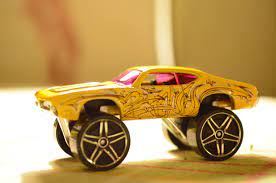
  Dmytro Kutniy When I was little, my favorite toy was a small yellow car. I got it for my fifth birthday from my parents. The car was small...